Showing posts with label Martha Rosler. Show all posts

Wednesday, 2 January 2013

RESEARCHIN' YO


When I first began in October I knew primarily that I wanted to collage. Collage was at that time the most exciting way of working I thought one could do, sure that sounds a little small minded, but after discovering Gelstans Cutting Edges Contemporary Collage reference book, with all its beautiful and creative images, I knew I wanted to make some of that. The whole underlying theme of collage: recycling was particularly important to me; the process of ‘regenerating’ old resources by cutting them out and placing them somewhere else. I love the way sections of photographs taken decades and distances apart could be suddenly having a conversation together. The idea of giving life and purpose back to these old photographs or magazines is brilliant, sustainable and (thankfully) cheap. Of course that’s not to say that now months later my opinion about collage has changed entirely, but I started out wanting to explore a particular practise and the development of my concept and interests ended up dominating more and subsequently the practise changed.


While process itself can be an exciting thing to develop, I needed to be using my particular practise to make work about something. Having a concept is really important for me, it enables me to really explore something and use a particular medium to make a response. Initially I wanted to respond to something I feel really strongly about; the sexualisation of girls. Girls from such a young age are being objectified and made to feel being ‘sexy’ is something they should worry about when they should just be playing and growing up in their own time. This loss of childhood is almost encouraged by society, with padded bikini tops for kids and ‘sexy’ Halloween costumes and horrifically the new trend of virgin waxing. Girls as young as eight are engaging in this ‘treatment’ to ensure that they never grow pubic hair, which according to Wanda Stawczyk from Wanda’s European Skincare saves your child a lifetime of waxing so that you can put the money in the bank for her college education instead! While sexism is not as rife as it used to be, in that you probably won’t be the one fired if you report that your boss had sexually assaulted you, attitudes to women have changed. Probably as result of pornography being so readily available and young boys (and girls) get exposed to it at such a young age, certain types of behaviour are deemed acceptable and expectations of women are becoming so unequal to that of men.
While this whole topic is something I was so interested in, I realised I was being unrealistic; I was looking at too broad a subject and would have to narrow it down.
But also I realised that with regards to the sexualisation of young girls and all the connotations that follow it such as the sex trade, sensitive as I am, I knew it would only distress me. As immature as that seems, I didn’t want to make work that would leave me hating society and besides it was far too broad a topic to really explore anything well enough for the work to become relevant or poignant. 
In the end I had to be selective and realised that I could explore something similar by concentrating on the themes of family life and role models. I was not entirely sure how I was going to transpire this theme into collage but I began to collate resources from which to work.

After exploring various old bookshops and charity shops I had collected a number of exciting resources, like dozens of old photographs, some of the same families at different times. There were a number of portraits of whom I’m assuming to be three sisters taken over what looks like a period of 5 years. The way their age process was documented in such a regimented fashion but then wound up being sold for 50p each in a charity shop, says something about the fragility of life. 
I also found a number of copies of ‘Housewife’ (the magazine of better living) and ‘Homes and Gardens’ from the 60’s and 70’s and a number of old sewing patterns. The magazines were filled with handy tips on how to cook the best dinners, keep the cleanest house and how to keep the husband happy, the latest inventions ‘essential for the modern housewife’ and the wonders of Branston Pickle, reinforced by the  persuasive beaming faces of the housewives. It was so strange how those ideals were so dominant for such a proportion of women in a way that just isn’t the case nowadays, while women are more concerned about their careers and being famous.

Not entirely sure how to proceed with the work, I began initially by working into some of the photographs, taking a more literal attempt on emphasising the facade of happiness. I began working with the imagery of smiling babies from the magazines and a vintage cake-decorating guide I found. In the guide there were recipes on how to create ‘Cakes to Make Your Reputation’, which I thought was brilliant starting point. 

As a preliminary collage I combined imagery of ‘cutie pie’ babies with perfectly iced cakes, elegant housewives standing proud next to her creations, and babies and women made from cake recipes.  The fusing of stereotypical housewife imagery with enthusiastic slogans and smiling children was all too sickly sweet and the ironic tone came through quite well. 
I also tried to create eeriness within the photographs by adding a red element to them. My idea was to suggest that there was something not as it seemed within the landscapes. When I explained it during the presenting contexts presentation my peers understood that, but I don’t think it was as successful as the initial collages I made, rather too ambiguous, and in a way it kind of ruined the photographs. However all these early pieces of work, while an acceptable first attempt, were too obvious and not skilled enough, there was no depth to them; they were at a second look exactly the same as when you first glanced at them. I wanted my work to be interesting enough so that the viewer would be able to and want to, draw their own conclusions about it.


I started to look into a variety of feminist artists such as Martha Rosler and her film ‘Semiotics of the Kitchen’ a satirical and blunt portrayal of being a housewife in the 60’s. Her deconstruction of being a housewife through her active display of alphabetized kitchen utensils in a frustrated and violent manner emphasised the suffocation and subdued anger that was felt by these women. 
This theme is supported by literature such as Richard Yates’ Revolutionary Road. The novel was such a perfect example of how this idealised family life was not ideal for everyone, published in 1961, it proved that there were women out there who wanted more than to be a good housewife, and keep the family home. It is such a beautifully written novel, and the film version too is so visually beautiful and influential to my ideas.

I have also been looking into Tracey Emin and Sarah Lucas; both very interesting artists under the feminist title, and both whom I saw at London’s Frieze Art Fair in October. Emin’s piece that really stood out for me was ‘Head Falling’ an illustration of a female figure stitched in black onto calico and while it is not collage, there was an elegance within the piece and a subtlety that is echoed in collage. The work of Sarah Lucas is also really exciting, ‘Mumum’ her hanging chair, made from fluff-filled tights was on display in Sadie Coles’ booth. That piece really interested me because it looked like there was such strength to the work as if it was made of marble but in reality was so fragile, which echoed the vulnerability of this discontented housewife image I have in my head; who for all anyone can guess seem so perfectly happy but inside is totally in anguish. Lucas’ work generally is very exciting as a feminist reference, her sculptures are so evocative and honest like Emin’s but they are suggestive enough to allow the viewer to read into them what way they like. For instance ‘Bitch’ is a simple construction with a lot of meaning: a small table with a t-shirt stretched over it, beneath the table under the t-shirt two hanging melons and a vacuumed packed smoked fish attached to the far end of the table. It is a portrait of the object of desire, a bent-over female body, inviting. When in reality, it is nothing but a few objects arranged in a particular way; crude symbols that hint at female structure. I made ‘Fried Eggs’ as a personal response to her self portrait. I wanted to reflect the sense of her work but without using the obvious medium of sculpture so I responded in the practise I knew, although at this point there was an underlying desire to experiment with sculpture but I didn’t feel like I had exhausted the collage yet.


A more relevant artist in terms of practise was Tom Partridge at the Nottingham Castle Open Exhibition in 2012. It was so exciting to see contemporary collage in an exhibition; ‘Hot Head’ and ‘The Pond’ were evidence that there is still merit in collage. The pieces themselves were relatively simple arrangements, but with a lot of beauty from the shapes constructed, and again there is that wonder of creating a conversation between various materials that would have otherwise never come together.

I began to experiment with the display of the work, originally it had only been upon paper and I had either pinned it onto the wall or framed it. But I wanted the work to have a more strength about it and I thought that by arranging the pieces on wood that could be achieved. Priming and then washing with a pale oil colour, I had already a surface that was so much more interesting than a plain sheet of paper. I experimented with adding glaze; when added onto photographs it created a shinier, wetter appearance which looked interesting against the glazed wooden boards and reflected that shiny facade of perfection. But also the contrast of matt and shiny created an interesting relationship between the imagery and the board as well.

Because I was not sure which method of display worked best; for the Show and Listen I exhibited two pieces, ‘Her Shapes’; a minimalistic collage made up of five pieces on wood. The imagery is obvious; cut into representative shapes but also ambiguous enough in that the viewer can decipher what the shapes really represent. The other piece was ‘Untitled Nurture’, a suggestion of breastfeeding as a baby looks over at its mother whose breasts are made of an icing gun, pointed toward him, which is presented on mount board in a black frame. There was not a preferred one style at all, they felt that both ways of displaying the work worked well; the glass and thick black frame reflected the facade of perfection as if everything was all untouchable and the wooden board had more of a depth and materiality about it that was liked. I really enjoyed that process of priming the boards and working on them, it was all very new and exciting to me, despite being a time consuming process.
 Here’s an example of matt imagery onto the shine of the wood; it’s really simple but I think by having the blue wash and slight shine, the piece is much more interesting.


After I enjoyed deconstructing the female form into basic shapes as in ‘Her Shapes,’ I wanted to continue with the symbolic theme, and began to look into circles. I was interested with what was associated with them with regards to women; the obvious immediate physical resemblance of breasts or the roundness of a pregnant belly, or less physically; the circle of motherhood, giving life. Like Rosler’s ‘Semiotics of the Kitchen’; the semiotics of circles are very interesting.


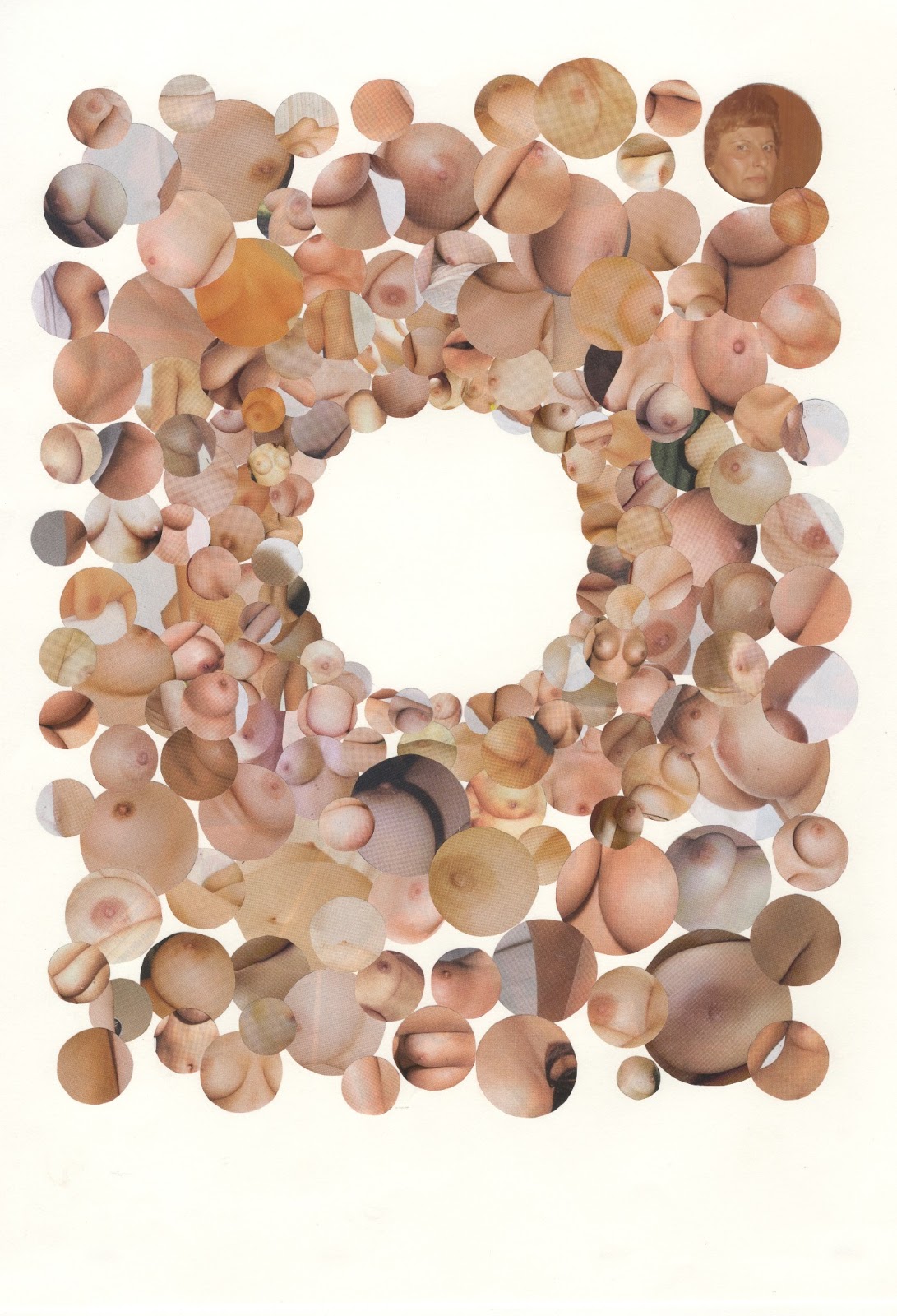
 Encouraged by the reaction of ‘Untitled, Nurture’ at the Show and Listen, I created this piece ‘Tits’ made entirely of breasts. Circles within circles; I wanted the imagery to be feminine not sexual, or if it came across that way to be an appreciation of the female form without the graphic imagery despite sourcing the images from porn magazines. While the piece was appreciated by a number of (male) students, I don’t think it really worked that well in relation with what I was trying to achieve, it was an experiment, but was too obvious and brash, there needed to be an elegance that I seemed to be achieving when there’s more white space on the page.


 A different route I went down was to combine female imagery with that of the domestic such as household items and kitchens; this is an example of a piece where I began to merge a content looking woman with kitchen cupboards. I was aiming for the integration of her feminine curves with the sharp edges of the counter-tops to be a representation of the idea that she's is losing her femininity as she becomes more of an object or rather 'objectified' by the male viewers.  While I do not think that was particularly clear, the imagery is quite interesting aesthetically, particularly the contrast of curves with shape lines. I think the concept of de-feminisation is really interesting;  when I spoke to woman who was living in London in the 60's when sexism was particularly rife, she told me how as a result of unwanted male attention she ended up trying to de-feminize herself by changing the ways of dressing, such as hiding her curves underneath quite 'male' clothing. This modification from a feminine female to an androgynous identity is something I am quite interested in exploring further.


  However at this point I didn’t feel as if I had quite  exhausted the use of circles, and began to use them differently to ‘Tits’; in block colour and in moderation!  ‘Perfection Reflection’ was thus made from that, I wanted to carry on the amusing appreciation for breasts by having orange bubbles emerge from them like a bubble gun. Unlike ‘Untitled Nurture’ there was none of the obvious mothering themes but by having the boy look up at her in wonder; I was trying to capture that ability to mesmerise and awe, that the perfect housewife has, according to Good Housekeeping!

While the circular imagery is interesting, and aesthetically pleasing particularly in a bright colour, I have begun to realise that the shape is not as important as I wanted it to be, and in fact I have begun to be disillusioned with solely working in collage. The enjoyment I felt by painting and working with the wood was partly because I was so excited to be doing something other than cutting and sticking for a change.
 I do not want to stop collaging with my resources just because I want to physically make something different, I also feel now I need to move away from collage and take the work into a different space. Making it relevant for nowadays is the challenge for the moment. I need to question what it means to be a woman in this century instead. Possibly having been subconsciously inspired by Sarah Lucas’ work, I really want to explore a more sculptural practise. I have begun to investigate what being a woman means to various women of different ages, and I plan to use their opinions to make a response that id more sculptural. The work is definitely not yet finished and I am really excited about what I can make in the future, when exploring new mediums and newer ideas.


Friday, 23 November 2012

CONTEXTualizing it all YO


Feminist art work is becoming more and more fundamental in my practise. The unequivocal attitudes on morality and womanhood are so inspiring and relevant; how women are scrutinized and treated and the assumptions and expectations that are made of them are all key aspects to my current ideas. The practise of collage is a process that I think is really reflective; it is work that requires a sensitivity and focus. I want my pieces to have a meaning that is forceful, while maintaining that beauty, like the topless warriors from Ukraine, imagery is really important. Whether it’s a cold dramatic display of kitchen utensils, or evocative scenes described in a novel or sensitive embroidery; in the kitchen, on the streets, in a gallery, the predilection for a sexual equality is notable.


 The work of Martha Rosler has been very influential to my current practise. ‘Semiotics of the Kitchen’ is a sarcastic comment on the role of women in the 60s. Semiotics meaning the study of signs, Rosler uses herself as a ‘symbol’ of femininity, filming herself in the traditional domain for a woman; the kitchen. In the film she proceeds to name and display like a sign, the different elements that make up a woman’s day-to-day existence; the kitchen utensils; ‘A’ for ‘Apron’ etc. Her movements are dark and static, instigating nervousness from the viewer, as we watch her coolly and violently demonstrate each utensil, deconstructing the classic image of a woman in the kitchen. Her movements become even more aggressive as she transforms even the safest objects into weaponry; brandishing each article with a silent fury that suggests a breakdown is imminent. This darkly humorous piece of work is such a simple but impassioned representation of the repressed housewife.


Tracey Emin, the ‘bad girl’ of British art. Her oeuvre has posed serious feminist questions about women’s sexual responsibility; her consistent confessional and autobiographical approach within her work, which along with her use of the domestic aesthetic, connects her to the practices of feminist artists such as Rosler. However it is not that work that I am interested in, seeing as her work has apparently changed; from the bluntness of ‘My Bed’ she has now a new opus; one of more subtlety and sensitivity. In her latest exhibition She Lay Down Deep Beneath The Sea’ at the Turner Contemporary she reveals a sensitive installation that explores the themes of love, sensuality and romanticism. 
The particular piece that is so exciting is ‘Head Falling’ being interesting aesthetically because it appeared to be a sketch in ink, but on closer inspection revealed to be a piece of embroidery. The effective embodiment of the activity of ink through the slow process of embroidery is fantastic. The subtle deception and enlightenment that the piece provides is so revealing and rewarding. There’s also a tenderness and honesty that’s poignant in her documentation of her relationship with herself, men and love.


Máximo Tuja’s work is really exciting. When I want an example of modern day collage where the time and skills are evident, I look to ‘Max-o-Matic’.  It reassures me that the time spent is worth it.  His pieces are so brilliant and exciting to look at; a mixture of subtle and outlandish arrangements. I like the blending and indistinct overlaying of black and white imagery like the faint deception of Emin’s ‘Head Falling’ to obvious bold compositions. Despite most of the work untitled and the content not about sexual equality, it is a medium that I am infatuated with, when I see his work I am suddenly filled with a desire to get out my scalpel and cut paper. 
 
‘Cutters’ a group exhibition curates by James Gallagher, reaffirms that collage is back and better than ever.


Revolutionary Road is such a useful insight into the housewives in the sixties, of course American life differed from the English, but when considering the classic housewife I automatically refer to the character of April Wheeler in Richard Yates’ classic.  The novel is a portrait of a failing marriage between a young couple in their prime, both looking for extraordinary things. Frank and April; always the first the first to throw a contemptuous remark about the suburban life, an existence they outwardly resented and with a smug satisfaction believed they were indifferent to, until they realise they are wholly immersed in this ‘ideal’ of suburban life. The story is relevant not just for the setting, but for an example of a marriage failing and animosity incited for want of a different lifestyle. The dialogue is used brilliantly to reveal these concealed resentments. We see the unravelling of the marriage largely from Frank’s point of view and hear conversations that he imagines having with his wife, cleverly being that they are derived from what husband and wife may have been able to say to each other, had suburbia not smothered them whole. April’s attempts to escape this mundane life escalate from harmlessly taking part in an amateur dramatic play that wasn’t as Frank put it “exactly a triumph or anything..?” to more dramatically inducing her own miscarriage. April had defiantly resisted suburbia’s attempts to smother her dreams of escaping this suffocating lifestyle, so much so that she died for her cause. The suffering of being a housewife may not be physical and violent, but oppressive in its own way; a smothering of ambition and freedom.

FEMEN are the infamous group of topless Ukrainian female activists, who use their bodies to stand defiantly for sexual and social equality in different parts of the world. They describe themselves as soldiers; morally and physically, provocatively fighting a war on discrimination standing proudly topless and adorned with a symbolic wreath of flowers. Their naked bodies echo the women of Amazonian tribes; their strength but also the sacredness of their form. For the women of FEMEN; to be naked is to be free. These aren’t meek compliant girls, these are women who have been beaten and imprisoned for standing up for what they believe in; a new wave of feminism; women who are undermining the patriarchal world all its forms from the church to the sex industry ‘bringing neurosis and panic’ to the men by means of their intellect, sexuality and agility. In Eastern Europe there is a disturbingly high rate of sex workers; Kiev has become notorious for ‘sex tourism’. While the method of legislation; criminalising the person who engages the services of a prostitute is unsuccessful in Ukraine only radical measures; protests and shock tactics can make society change its opinion and compel parliament to change the law. Their work is so admirable, compelling me to want to rip off my clothes and stand with them. Their aim is to empower women. Subtlety is not an option; I want my work to be reflective of their struggles. It encourages me to make my images bolder and more audacious. It doesn’t mean that the craft of collage has to be dismissed, it is fundamental; it just means subtle mocking of the 60’s American housewife isn’t the only source of commentary.


 Bibliography                      
Reckitt, H. (2001). Art and Feminism. London, Phiadon Press Limited
Januszczak, W. (2012). Home Is Where The Art Is. Available: http://www.thesundaytimes.co.uk/sto/culture/arts/Visual_Arts/article1044648.ece.[Last accessed 20th October 2012]
Wullschlager, J. (2012). Traces of Tracey. Available: http://www.ft.com/cms/s/2/3eb19534-a4e1-11e1-9a94-00144feabdc0.html#axzz2APqS62nY. [Last accessed 19th October 2012]
Turner Contemporary. (2012). News > She Lay Down Deep Beneath the Sea: Tracey Emin at Turner Contemporary. Available: http://www.turnercontemporary.org/news/she-lay-down-deep-beneath-the-sea-tracey-emin-at-turner-contemporary. [Last accessed 22nd October 2012]
Mullan, J. (2004). Guardian Book Club; Left Unsaid. Available: http://www.guardian.co.uk/books/2004/sep/18/featuresreviews.guardianreview26. [Last accessed 16th November 2012]
Klanten. R, Hellige. H, Gallagher. J. (2011). Cutting Edges Contemporary Collage. Berlin, Gestalten
 Gallagher, J. Cutters (2010). (collage) [image online] Available: http://www.maxomatic.net/20563/171732/collages/cutters-2010. [Last accessed 17th November 2012]
Yates, R.(2007). Revolutionary Road. London : Vintage
Wilsher, K. (2012). Femen's Topless Warriors start Boot Camp for Global Feminism. Available: http://www.guardian.co.uk/world/2012/sep/22/femen-topless-warriors-global-feminism. [Last accessed 4th October 2012]
Camatsos, S. G . (2012). FEMEN sheds light on Ukrainian sex industry [Interview: Anna Hutsol]. Available: http://femen.org/en/about [ Last accessed 17th November 2012]
Femen. About Femen. Available: http://femen.org/en/about. [Last accessed 17th November 2012]